 niccleave

Selecting conveyor maintenance hardware directly governs how rapidly an unplanned operational stoppage gets resolved across manufacturing and logistics facilities. Splicing failures, uneven joints, and pulled fastener hooks often trace back to sub-optimal installation tooling rather than defective lacing materials themselves.
Plant engineers and procurement specialists must evaluate repair tools by balancing carcass construction, maintenance location, and mechanical leverage. Overlooking these operational factors risks chronic belt mistracking, premature splice pull-out, and elevated safety hazards for maintenance crews.
Deploying a properly specified belt lacing machine establishes repeatable joint integrity, ensuring that every wire hook penetrates cleanly without bruising underlying fabric plies. A structured purchasing approach protects capital investments while slashing conveyor downtime across material handling networks.
Structural Mobility and Installation Speed Under Production Pressure
Physical maintenance environments vary significantly between elevated overhead sorting lines and confined transfer chutes. Maintenance crews operating in restricted clearances require compact, lightweight tools that technicians can transport solo across catwalks to lace splices directly on the conveyor structure without unthreading belting.
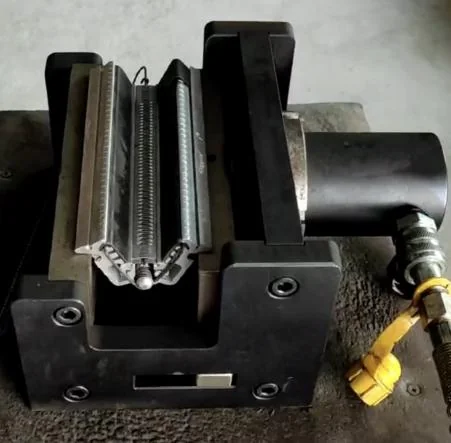
High-throughput logistics hubs and industrial terminals experience demanding schedules that make long splicing windows economically intolerable. Utilizing a specialized hydraulic belt fastener machine in a central workshop streamlines repetitive joint fabrication, allowing operators to prepare replacement segments with uniform holding force in minimal time.
Portability must never compromise chassis rigidity or alignment stability during on-site splicing procedures. Lightweight aluminum frames offer mobility across multi-level facilities, yet structural deflection under clamping loads can cause uneven hook embedment across wider conveyor carcasses.
Evaluating setup time alongside actual installation speed reveals the genuine field efficiency of any prospective tool. Quick-locking clamp bars, intuitive comb retainers, and toolless gauge adjustments prevent costly delays during time-sensitive overnight belt replacements.
Mechanical Force Delivery and Clinch Profile Consistency
Compression force dictates how securely fastener legs grip belt tensile cords and whether hook points achieve a smooth, low-profile finish. Insufficient pressure leaves protruding metal knuckles that collide violently with primary belt scrapers, return idlers, and skirtboard rubber seals.
Manual screw drives and hand levers demand substantial physical exertion, which frequently leads to uneven penetration force on wide belt seams. Automated fluid power overcomes this physical limitation by distributing high tonnage smoothly across the entire width of the fastening comb.
Technical documentation from manufacturers like Intake confirms that uniform hydraulic pressure drives fastener legs through tough carcass layers without shearing load-bearing cords. Controlled pressure cycles ensure that every hook leg closes parallel, maximizing joint retention across high-tension systems.
Integrating an automated hydraulic belt fastener machine eliminates operator fatigue as a variable in splice quality, creating identical mechanical seams across multiple maintenance shifts. Uniform clinch profiles safeguard expensive conveyor components from abrasion and prolong joint operating life.
Belt Thickness Range and Fastener Dimensional Compatibility
Conveyor belting spans a wide spectrum of profiles, ranging from thin single-ply thermoplastic food belts to thick multi-ply rubber packages. Splicing tools must accommodate specific belt gauges and fastener styles, since forcing oversized hooks into narrow lacer combs distorts critical pitch spacing.
Purchasers should verify whether a candidate belt lacing machine features interchangeable comb segments or fixed-pitch guide plates. Modular comb architectures allow maintenance departments to service diverse production lines utilizing both carded wire hooks and continuous-bar reinforced fasteners on a unified platform.
Proper penetration requires precise matching between anvil plate geometry, fastener wire diameters, and belt cover thicknesses. Improper anvil radius settings can over-crimp wire fasteners, fracturing metal legs at the hinge knuckle and inducing premature splice fatigue under dynamic tension.
Systems developed by Intake accommodate a broad spectrum of industrial wire hook fasteners and common-bar assemblies, ensuring adaptable clamping geometry across light and medium-duty belt inventories. Broad compatibility lowers operational overhead by consolidating the total number of dedicated splicing rigs required on-site.
Joint Alignment Accuracy and Square-Cut Integrity
Mechanical joint longevity depends directly upon installing fasteners precisely perpendicular to the belt center line. Even minor angular deviations introduce camber into the spliced loop, causing the belt to drift off-center, scuff frame structures, and spill cargo.
Secure clamping mechanisms must lock the prepared belt end firmly against internal squaring stops throughout the clinching operation. Dual-action hold-down bars prevent carcass creep and lateral shifting while the lacer head traverses the belt edge during hook compression.
Hinge pin cavity formation requires strict dimensional retention during fastener insertion. High-precision tooling maintains uniform loop openings across the full width, permitting retaining pins to slide through freely without binding or introducing localized hinge distortion.
Operating a modern belt lacing machine equipped with built-in squaring guides guarantees that fastener loops align squarely across the splice seam. Precise mechanical alignment ensures balanced tension distribution across the hinge pin, preventing localized point loads that cause premature hinge failure.
Tool Durability, Component Modularity, and Long-Term Value
Abrasive dust, moisture, and washdown chemicals found across processing facilities quickly degrade inferior repair equipment. Specifying repair machines built with heat-treated alloy steel combs, hardened anvil guides, and corrosion-resistant finishes prevents premature tolerance wear and mechanical jamming.
Hydraulic power units demand robust safety controls, including calibrated pressure relief valves and sealed reservoirs that prevent fluid contamination. Incorporating overload protection shields internal piston seals from pressure spikes during high-tonnage clinching on dense, multi-ply belting.
Procuring a dedicated hydraulic belt fastener machine from Intake ensures direct access to standardized hydraulic couplings, durable hoses, and precision-machined replacement heads. Reliable technical documentation and readily accessible spare parts protect industrial operators from prolonged downtime when tooling requires refurbishment.
Maintenance managers must weigh upfront capital outlays against the recurring operational expenses of unscheduled conveyor downtime. Selecting high-grade mechanical belt repair machinery yields substantial financial returns through reduced labor hours, extended splice endurance, and reliable conveyor throughput.