 niccleave

Aluminium castings can look correct at the design and process planning stages yet still develop porosity, cracking, shrinkage, cold shuts, or dimensional problems after production begins. These aluminium casting defects are rarely caused by a single parameter. Alloy selection, melt quality, mold geometry, metal flow, cooling conditions, and solidification are closely connected. A small weakness in one area can create a defect that only becomes visible during machining, pressure testing, surface finishing, or final assembly.
For engineers and sourcing teams, the more useful question is not simply what aluminium casting defects exist, but why they appear and how they can be addressed before they increase tooling changes, scrap, and production costs.
Why Aluminium Alloy Selection Matters
The selected aluminium alloy establishes the basic casting behavior of the material. Different alloy compositions have different fluidity, freezing ranges, shrinkage characteristics, and resistance to hot tearing. An alloy that performs well for one geometry may create difficulties when applied to a thin wall, deep cavity, or structurally complex component.
Fluidity is particularly important for parts with thin sections or long flow paths. If molten aluminium loses heat too quickly, it may not completely fill the cavity before solidification begins. This can contribute to cold shuts, misruns, or incomplete features.
Solidification behavior also affects internal quality. As aluminium changes from liquid to solid, its volume changes and the remaining liquid must compensate for contraction. If feeding is insufficient, localized shrinkage porosity can develop. Alloy selection therefore needs to be considered together with part geometry and the intended casting process rather than treated as an isolated material decision.
How Melt Quality Contributes to Aluminium Casting Defects
Even with a suitable alloy, melt quality can determine whether a casting achieves the required internal integrity. Hydrogen absorption, oxide formation, inclusions, and turbulence can introduce defects that may remain hidden beneath the surface.
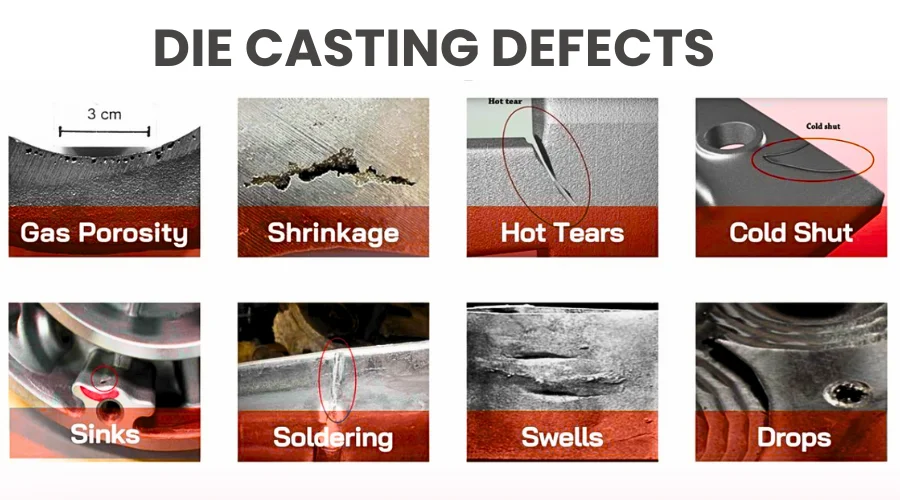
Hydrogen and Gas Porosity: Gas porosity forms when gas becomes trapped inside the metal during filling and solidification. Poor venting, turbulent flow, excessive release of gas from process materials, and inadequate melt preparation can all increase the risk. The problem becomes more significant when the component will later undergo machining, pressure testing, or sealing. A casting that appears acceptable externally may reveal internal voids once a critical surface is exposed. Controlling metal flow, improving venting, managing process materials, and using suitable vacuum assistance where required can reduce this risk. HordRT’s die casting capability is supported by engineering review and quality inspection, allowing potential process risks to be considered before production.
Oxide Films and Inclusions: Molten aluminium readily forms oxide films when exposed to air. Excessive turbulence can fold these films into the melt, while foreign particles can introduce additional inclusions. These discontinuities may reduce mechanical performance and contribute to machining or finishing problems. Stable melt handling and controlled filling are therefore important parts of casting quality rather than secondary process details.
Shrinkage: Shrinkage occurs as aluminium cools and solidifies. When liquid metal cannot adequately feed regions that are still contracting, internal voids or surface depressions may appear. Thick sections and isolated masses are particularly important because they generally remain liquid longer than surrounding areas. This makes local geometry a major consideration when investigating aluminium casting defects.
How Mold Design Influences Aluminium Casting Defects
A casting mold does more than reproduce the external shape of a component. Its geometry determines how metal enters the cavity, how air escapes, and how heat moves away from the casting.
Wall thickness should be as consistent as practical. Sudden changes from thin to thick sections can create different cooling rates and localized hot spots. These areas can become vulnerable to shrinkage or distortion.
Sharp internal corners can also concentrate thermal and mechanical stresses. Adding suitable radii helps improve metal flow and reduces stress concentration during solidification.
Draft angles are important for releasing the casting without damaging the mold or the component. Core design deserves equal attention because poorly supported or unnecessarily complex cores can affect dimensional stability and create difficult filling or venting conditions.
For complex parts, these considerations are most effective when reviewed before tooling is manufactured. HordRT integrates DFM review into its project workflow, with engineers reviewing designs and identifying manufacturing risks before production begins.
Understanding Solidification Related Defects
Solidification is one of the most influential stages in casting quality because temperature, feeding, and geometry interact continuously.
Shrinkage porosity is more likely when a thick region remains liquid while surrounding material has already solidified. Hot tearing can occur when the metal is partially solidified but cannot accommodate contraction because of restricted movement or unfavorable stress conditions.
Cracking can also develop when thermal stresses exceed the local strength of the material. These problems are not always solved simply by adjusting one machine parameter. The underlying geometry, alloy, gating arrangement, and cooling strategy may all need to be reviewed together.
How Gating and Risering Control Solidification
The gating system controls how molten aluminium reaches the cavity. Gate location, runner geometry, filling sequence, and flow velocity influence turbulence, temperature loss, air entrapment, and the way different sections solidify.
For castings requiring controlled feeding, risering or other feeding strategies help compensate for metal contraction during solidification. The objective is to direct solidification toward areas where feeding can remain effective rather than allowing isolated hot spots to form internal voids.
A well-designed system therefore considers both filling and solidification instead of treating them as separate stages.
Why Thick to Thin Transitions Increase Defect Risk
A sudden transition between a thick boss and a thin wall creates different thermal conditions within the same component. The thin area may solidify quickly while the thicker region remains molten. As the thicker section eventually contracts, the surrounding solid material may restrict feeding and movement.
This is why apparently simple geometric changes can produce recurring aluminium casting defects.
Where possible, gradual transitions, suitable fillets, controlled wall thickness, and properly positioned gates can make the casting easier to fill and solidify consistently.
Using Simulation to Predict Aluminium Casting Defects
Casting simulation can provide useful insight before physical tooling is finalized. Engineers can evaluate filling patterns, potential air entrapment, temperature distribution, solidification behavior, and areas with elevated shrinkage risk.
Simulation does not replace manufacturing experience, but it can reduce reliance on trial and error. When combined with DFM review, it gives engineers an opportunity to identify potential problems while changes are still relatively inexpensive.
This approach is particularly valuable for complex aluminum alloy components where tooling modifications after production begins can affect both schedule and cost.
Improving Casting Quality Starts at the Design Stage
The most effective way to control aluminium casting defects is to address their causes before they become production problems. Material selection, wall thickness, corner geometry, draft, cores, gating, venting, cooling, and inspection requirements should be evaluated as one connected manufacturing system.
This is where HordRT’s integrated manufacturing model provides practical value. Its capabilities cover tooling, CNC machining, die casting, sheet metal fabrication, and other processes, allowing project requirements to be reviewed across different manufacturing stages. Its Zhongshan facility specializes in precision CNC machining, high pressure die casting, and sheet metal fabrication, while its engineering workflow includes DFM review before manufacturing.
HordRT also supports projects from prototypes through production, with quality inspection incorporated into its manufacturing process. This helps connect design decisions with actual production conditions rather than evaluating casting quality only after parts have been produced.
From Defect Prevention to Production Stability
Aluminium casting defects are often symptoms of interactions between material, geometry, metal flow, and solidification. Porosity may point to melt or filling conditions, shrinkage may originate from geometry and feeding, while cracking can involve both alloy behavior and thermal stress.
For this reason, defect prevention should begin before the mold is cut. A design that considers casting behavior from the start gives manufacturers more opportunities to control filling, cooling, dimensional accuracy, and internal quality.
With DFM review, die casting expertise, tooling support, and integrated manufacturing capabilities, HordRT helps customers evaluate these factors earlier in the production process. The result is a more practical path from CAD design to a casting that is ready for machining, finishing, assembly, and real-world application.