 niccleave

As distributed energy systems become more common, the connection between solar panels, battery storage, and inverters has become a key topic for installers, system integrators, and OEM partners. A properly designed energy storage system does more than store excess electricity. It improves self-consumption, enhances backup capability, and creates a flexible platform for future expansion.
Among various configurations, Wall-Mounted 51.2V LiFePO4 Home Battery solutions have gained popularity because they combine high energy density with space-saving installation. Their compact design and scalability make them suitable for residential energy projects and customized storage applications.
How Solar PV Systems Generate and Deliver Energy
Solar photovoltaic (PV) modules convert sunlight into direct current (DC) electricity. During the daytime, electricity generated by the PV array is first used by household loads. If generation exceeds consumption, surplus energy can either be exported to the grid or stored in batteries for later use.
However, most household appliances operate on alternating current (AC). Therefore, an inverter is needed to convert DC electricity into usable AC power. When battery storage is added, the inverter also manages charging and discharging processes to ensure stable system operation.
This combination of solar panels, battery storage, and inverters forms the foundation of modern residential energy systems.
The Role of Inverters in Battery Integration
The inverter acts as the control center of the entire energy storage architecture. It manages energy flow between photovoltaic modules, loads, the utility grid, and batteries.
Hybrid inverters are particularly suitable for systems with battery storage. They allow surplus solar power to charge batteries during the day and release stored energy when solar generation decreases or electricity demand rises.
Communication between the battery management system (BMS) and the inverter is essential. Data exchange helps optimize charging parameters, maintain cell balance, and improve system efficiency. Industry standards such as CAN and RS485 communication protocols are commonly used to ensure compatibility.
According to the International Energy Agency, battery storage combined with solar generation plays a significant role in improving renewable energy utilization and grid flexibility, especially in distributed energy systems.
Why Wall-Mounted Battery Systems Are Becoming More Popular
Compared with traditional floor-standing cabinets, wall-mounted systems occupy less space and simplify installation. Their compact design allows deployment in garages, utility rooms, and technical areas where installation space is limited.
Another advantage is modularity. Capacity can be expanded according to energy demand without changing the entire system architecture. This feature is valuable for OEM and ODM partners because it supports customized solutions across different markets.
The use of lithium iron phosphate chemistry further improves safety and reliability. LiFePO4 batteries provide excellent thermal stability and long cycle life, making them suitable for long-term energy storage applications.
Wall Mounted Home Battery Storage Solutions for Scalable Systems
A typical example is the Wall Mounted Home Battery Storage solution provided by Dyness. The company focuses on energy storage technologies and provides residential, commercial, and industrial battery solutions through distributors, installers, and OEM or ODM cooperation worldwide.
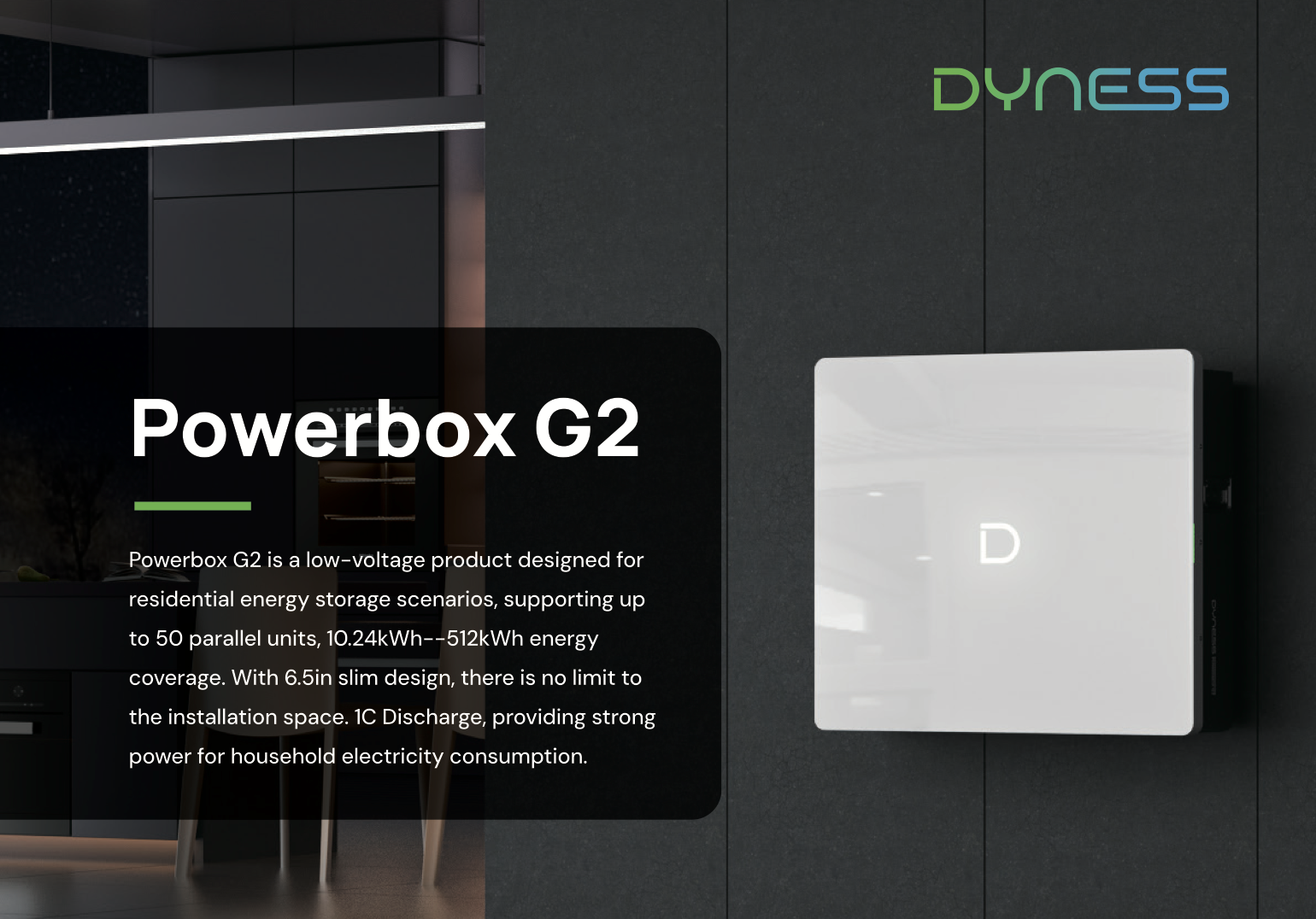
According to official product information, the Powerbox G2 is a Wall-Mounted 51.2V LiFePO4 Home Battery designed for low-voltage residential applications. The system has a nominal voltage of 51.2V and a nominal energy capacity of 10.24 kWh. It adopts lithium iron phosphate cells and supports both wall-mounted and floor-standing installation.
This Wall Mounted Home Battery Storage model, the Powerbox G2, also features IP66 protection, integrated Wi-Fi monitoring, and a maximum 1C discharge capability. One of its major strengths is scalability. Up to 50 units can operate in parallel, enabling system expansion from 10.24 kWh to 512 kWh. This flexibility provides more options for system integrators and customized projects.
How Energy Flows Between Solar Panels, Batteries, and Loads
During sunny periods, solar panels generate electricity and supply household loads. Excess energy charges the battery through the inverter. At night or during cloudy conditions, stored energy is released to support loads and reduce dependence on the grid.
In hybrid systems with backup functionality, batteries can also provide emergency power during grid outages. Intelligent energy management ensures that charging and discharging occur efficiently while protecting battery health.
Because the inverter continuously monitors battery status through the BMS, the system maintains balanced operation and maximizes cycle life.
Why Integration Matters for OEM and ODM Partners
System compatibility has become increasingly important in the energy storage industry. Integrators and equipment manufacturers need solutions that support multiple inverter brands and flexible configurations.
Wall-Mounted 51.2V LiFePO4 Home Battery products provide an efficient foundation for these projects. Their modular architecture simplifies transportation, installation, and maintenance while enabling capacity upgrades in the future.
As solar adoption continues to grow, the integration between photovoltaic systems, inverters, and battery storage will become even more important. For OEM and ODM partners seeking scalable energy solutions, a well-designed wall-mounted battery system offers long-term reliability, efficient energy management, and the flexibility required by modern distributed power applications.