 niccleave
Maintenance teams often need elevated access for jobs that take minutes or a few hours rather than an entire shift in one location. A vertical mast lift can suit this pattern because it combines a dedicated platform with compact movement and direct vertical elevation. For facilities, warehouses, retail spaces, and commercial buildings, the right machine can make repeated short-duration tasks easier to organize without bringing in larger access equipment than the job requires.
Short Tasks Still Need the Right Access Method
Replacing a light fitting, checking overhead services, adjusting signage, inspecting ceiling components, or carrying out minor installation work may require access several metres above floor level. Although each task can be brief, workers still need a stable platform and a controlled method of reaching the work area.
Using the appropriate MEWP category helps teams plan these jobs consistently. HSE guidance recommends selecting equipment according to the work and site conditions, including ground conditions, access routes, operating height, and the intended work position. This is particularly relevant when the same type of short-duration task occurs repeatedly across a facility.
Why Compact Access Supports Repeated Work
Short-duration jobs often involve frequent repositioning. Equipment may need to move from one corridor, room, aisle, or service point to another within the same work period. A compact machine can therefore reduce the logistical burden associated with repeated access tasks, provided its dimensions and operating limits match the site.
The benefit is not simply smaller size. Teams should consider turning radius, travel speed, working height, platform capacity, and the available route. A machine that can move efficiently between task locations can be useful when workers complete several isolated maintenance points instead of remaining in one fixed work zone.
Vertical Mast Lift vs Scissor Lift for Narrow Work Areas
The vertical mast lift vs scissor lift comparison becomes relevant when the job requires vertical access but the available space is limited. A scissor lift generally provides a wider working platform, which can be useful when several workers or larger quantities of materials need to be accommodated.
A vertical mast configuration is centered around a narrower access footprint and vertical travel path. This can make the category relevant to work areas where platform size is less important than maneuverability and positioning. The correct choice still depends on the task, required platform capacity, floor conditions, access route, and machine specifications.
Why Frequency Changes Equipment Planning
A machine used once a month can be evaluated differently from one deployed several times a day. Frequent short-duration jobs place greater emphasis on repositioning, controls, charging, inspection routines, and ease of integration into daily maintenance schedules.
For these applications, procurement teams can estimate the number of access points completed per day and the typical distance between them. This helps determine whether a compact vertical mast lift can support the expected workflow more effectively than equipment designed for longer-duration or larger-scale work.
Consider Operator and Worksite Controls
Frequent use does not reduce the need for systematic checks. OSHA recommends a pre-start inspection before each work shift, including operating controls, emergency controls, tires, batteries, brakes, and other lift components. Work areas should also be inspected for overhead obstructions, unstable surfaces, slopes, debris, and nearby personnel.
For recurring maintenance programs, organizations can incorporate these inspections into standard operating procedures. Operators should also be trained for the equipment category being used. Where the work environment changes from one location to another, the assessment should be repeated so that a familiar machine does not lead to assumptions about unfamiliar site conditions.
When a Vertical Platform Makes Sense
A dedicated vertical-access platform can be considered for tasks where the target is substantially above the base and does not require the horizontal outreach associated with a boom lift. Typical applications may include building services, lighting, electrical work, inventory-related access, signage, and inspection tasks.
The machine should still provide adequate height and capacity for the specific job. Buyers should also check travel speed, turning characteristics, maximum working slope, battery arrangement, and overall machine dimensions. These specifications can influence whether the equipment fits a short-cycle workflow or creates unnecessary movement and setup requirements.
The ZMP09J From Zoomlion Access
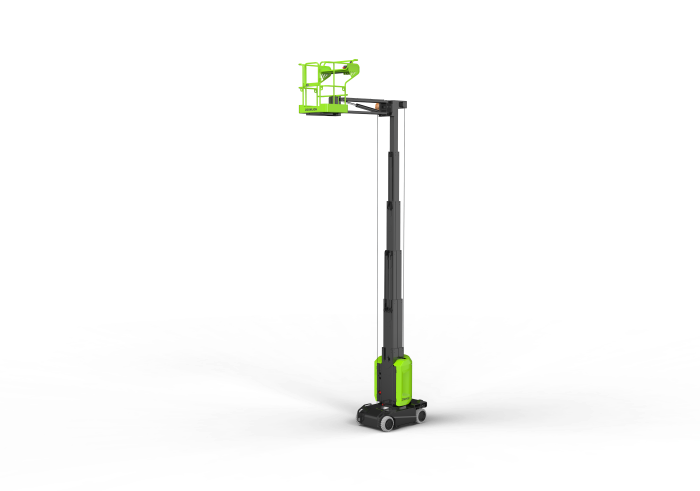
The ZMP09J from Zoomlion Access is listed as a vertical mast lift with a headline platform-height specification of 11.2 m. Its detailed specification chart lists 9.2 m for platform height when elevated, 200 kg platform capacity, and accommodation for up to two workers indoors or one worker outdoors. Gross weight is 2,990 kg.
The published performance data includes 4.5 km/h stowed driving speed and 0.5 km/h raised driving speed, with an outside turning radius of 1.61 m. The ZMP09J also lists 25% gradeability, a maximum working slope of 2.5°, and proportional control. These specifications provide useful reference points when assessing repeated short-duration access requirements.
Power Specifications for Routine Operation
The ZMP09J uses four 6V/240Ah batteries and a 24V/30A charger. Its lifting motor is specified at 24V/3 kW, while the drive system uses two AC 24V/0.7 kW motors. The machine uses rear-wheel drive and solid seamless tires, with listed lifting and lowering times of 42 and 40 seconds.
For facilities planning repeated tasks, these published figures can be compared with daily operating cycles and charging arrangements. Zoomlion Access also lists five vertical mast lift models in its current product range, including the ZMP04, ZMP06, ZMP06G, ZMP08J, and ZMP09J, covering different platform-height and capacity requirements.
Evaluating Zoomlion Access for Frequent Access Work
Zoomlion Access offers more than 100 MEWPs across five categories, including scissor lifts, telescopic boom lifts, articulating boom lifts, spider lifts, and telehandlers. Its vertical mast lift range provides another equipment category for applications where compact vertical access is a core requirement.
The practical question in a vertical mast lift vs scissor lift assessment is therefore not which category is universally preferable, but which machine matches the work location, platform requirements, mobility needs, and operating conditions. The ZMP09J provides 200 kg capacity, 9.2 m elevated platform height in its detailed chart, and a 1.61 m outside turning radius. Zoomlion Access gives buyers these published specifications for application-based comparison.
Build Access Around the Work Pattern
Frequent short-duration tasks reward equipment planning that reflects how work is actually performed. A vertical mast lift can be relevant when jobs are distributed across multiple locations and require a direct vertical access method with controlled repositioning.
The vertical mast lift vs scissor lift decision should be based on platform requirements, site geometry, working height, capacity, travel conditions, and frequency of use. The ZMP09J offers defined operating and power specifications for this evaluation, while Zoomlion Access provides a broader selection of MEWPs for different access requirements.