
 niccleave
Accuracy is one of the most important factors when dental professionals evaluate 3D printing technology. As digital dentistry continues to develop, clinics and laboratories increasingly rely on additive manufacturing to produce dental models, surgical guides, restorations, and other customized applications.
Printing precision directly influences the quality of the final product. For dentists using a dental model 3D printer, understanding technical specifications such as pixel resolution and printing precision can help determine whether a system meets clinical requirements.
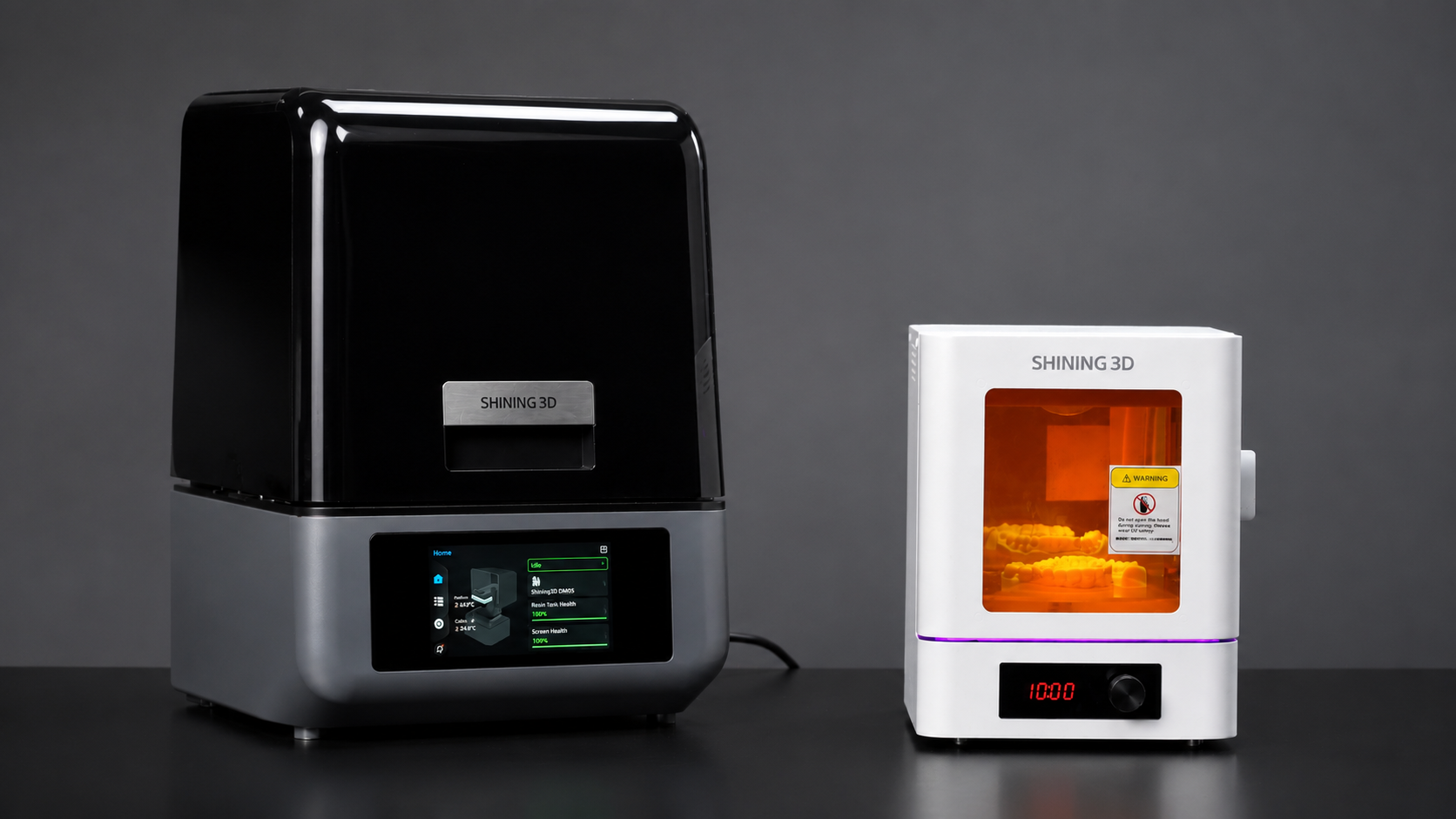
A 34 μm pixel size delivers ultra-fine surface detail for all types of dental printed parts. SHINING 3D DENTAL’s AccuFab-Aris chairside dental 3D printer adopts a 4K LCD light engine with 34 μm pixel resolution, with overall dimensional printing accuracy of ±50 μm. It supports full-range clinical production including dental models, surgical guides, temporary & permanent restorations, dentures, and occlusal splints.
What Does 34 μm Pixel Size Mean?
A micrometer (μm) equals one one-thousandth of a millimeter. In MSLA dental 3D printing, 34 μm refers to the horizontal pixel size of the projection screen, which controls the fineness of anatomical surface details such as tooth grooves and gingival contours. While the small pixel delivers smooth textures, the printer’s complete dimensional tolerance reaches ±50 μm for finished dental appliances, balancing fine detailing and consistent clinical fitting performance.
For a dental model printer, higher precision helps reproduce details such as tooth contours, margins, and surface structures more accurately. Although printing precision is important, it is only one part of overall print quality. The final result also depends on:
- Digital scan accuracy
- Design software quality
- Resin properties
- Printing parameters
- Post-processing procedures
A high-precision 3D dental model printer works best when combined with a complete digital workflow that controls each stage from scanning to final production.
Why Printing Precision Matters in Dental Applications?
- Improving Dental Model Accuracy
Dental models are widely used for diagnosis, treatment planning, education, and communication between dentists and patients. These models need to represent the patient’s anatomy accurately.
A dental model 3D printer with high precision can help reproduce detailed structures, including:
- Tooth morphology
- Occlusal surfaces
- Gingival contours
- Implant planning features
Accurate models allow dental professionals to evaluate treatment plans more effectively and improve communication with patients and dental laboratories.
- Supporting Surgical Guide Production
Surgical guides require accurate reproduction of planned implant positions. Even small deviations during manufacturing may affect how well a guide fits during clinical procedures.
High printing precision helps maintain the relationship between the digital design and the physical guide. This is why many dental professionals consider printer accuracy when selecting equipment for implant workflows.
A precise dental model printer can support not only model production but also more advanced digital dentistry applications when combined with suitable materials and software.
- Improving Restorative Dentistry Workflows
Restorative applications often require detailed reproduction of dental structures. Printed models can be used for designing and evaluating crowns, bridges, and other restorations.
A 3D dental model printer with accurate layer reproduction helps dental teams create physical references that closely match digital designs.
This can improve workflow efficiency by reducing repeated adjustments and supporting better communication between clinicians and technicians.
How Does the 34 μm Pixel Size of SHINING 3D DENTAL AccuFab-Aris Improve Dental Print Detail?
- High-Resolution Printing Technology
Resin-based dental printers typically use light-based curing technology to solidify liquid resin layer by layer. The resolution of the light source and display system influences how accurately the printer can reproduce digital information.
The AccuFab-Aris from SHINING 3D DENTAL features a 4K high-resolution LCD light engine with 34 μm pixel precision for fine anatomical details, delivering consistent printed dental models, surgical guides and restorations.
- Controlled Printing Environment
Stable printing conditions also influence accuracy. Factors such as temperature, resin condition, and mechanical stability can affect the final result.
Professional dental printers are designed to provide more controlled environments compared with general-purpose consumer 3D printers.
For clinics adopting a dental model 3D printer, stable performance is important because dental applications often require repeatable results across multiple cases.
- 34 μm Precision Compared With Lower-Resolution Printing
Lower-resolution printers may struggle to reproduce very small structures, especially in complex dental designs. Higher precision allows more detailed layer formation and smoother surface transitions.
For dental professionals, this can mean:
- More accurate model surfaces
- Better reproduction of anatomical features
- Reduced manual adjustments
- Improved workflow consistency
- Supporting Professional Dental Requirements
Dental manufacturing requires more than simply creating a physical object. Printed products need to meet specific functional requirements depending on their purpose. A high-precision dental model printer provides a stronger foundation for producing clinically useful models and devices.
However, dentists should evaluate the complete workflow rather than focusing only on one specification. Accuracy, material compatibility, software integration, and ease of use all contribute to successful implementation.
Choosing a Dental 3D Printer Based on Precision Needs
- Evaluate Your Clinical Applications
Different applications require different levels of precision. Before selecting equipment, dentists should consider what they plan to produce.
For example:
- Diagnostic models require detailed anatomical reproduction.
- Surgical guides require accurate digital-to-physical transfer.
- Restorative workflows require reliable surface detail and dimensional stability.
Understanding application requirements helps clinics choose suitable equipment.
- Consider Workflow Integration
A printer should work smoothly with existing digital dentistry systems. Compatibility with scanning technology, design software, and materials can influence overall efficiency.
SHINING 3D Dental provides an integrated digital workflow that connects scanning, design, and manufacturing processes. The AccuFab-Aris is designed to support dental professionals with a streamlined printing workflow for various applications.
- Look Beyond Precision Numbers
While 34 μm precision is an important technical advantage, dentists should also evaluate:
- Printing speed
- Material options
- Maintenance requirements
- Software experience
- Equipment reliability
A successful digital dentistry workflow depends on how well all these elements work together.
SHINING 3D Dental AccuFab-Aris and High-Precision Dental Printing
SHINING 3D DENTAL develops integrated digital dentistry workflows for dental clinics and laboratories. The AccuFab-Aris is a professional chairside dental 3D printing system compatible with dental models, surgical guides, restorations, full dentures and occlusal splints.
Equipped with a 4K high-resolution LCD light engine delivering 34 μm pixel size (with overall dimensional accuracy of ±50 μm), the printer is built with intelligent automated workflow modules to deliver consistent, finely detailed printed parts for daily clinical production.
For clinic and lab owners evaluating digital additive manufacturing equipment, selecting a printer with standardized optical and dimensional precision can stabilize daily output and expand the range of treatable dental cases.
Conclusion
34 μm pixel size delivers fine surface detail for dental printed parts, while AccuFab-Aris has an overall dimensional printing tolerance of ±50 μm. This dual precision design ensures stable output quality for dental models, surgical guides and custom restorations.
SHINING 3D DENTAL’s AccuFab-Aris professional dental 3D printer integrates complete hardware and software workflows. When dental clinic and lab owners evaluate 3D printing equipment, distinguishing pixel resolution from dimensional accuracy helps select systems that balance surface fineness and clinical fitting consistency.
With solutions like SHINING 3D DENTAL‘s AccuFab-Aris, dental professionals can adopt high-precision printing technology to support efficient and accurate digital dentistry workflows.


